
 Athens Photos
 Santorini Photos
 Crete Photos
 Meteora Photos
 Corfu Photos
More Culture Topics
- Ancient Greek Religion
- Greece Movie
- Greek Architecture
- Greek Art
- Greek Bible
- Greek Columns
- Greek Costumes
- Greek Culture
- Greek Jewellery
- Greek Key
- Greek Masks
- Greek Music
- Greek New Testament
- Greek Orthodox
- Greek Philosophers
- Greek Pottery
- Greek Radio
- Greek Religion
- Greek Sculpture
- Greek Tattoos
- Greek Temples
- Greek Theater
- Greek Tv
More Topic Categories
Related Destinations
Greek Key
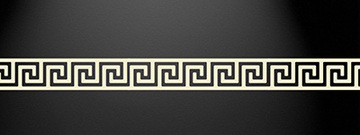 The Greek key or meander is an architectural and archaeological term that describes a decorative ribbon made of straight lines that are connected orthogonally. The meander was commonly used in Ancient Greece as a decorative element of the frieze of various buildings. Variations of the Greek key include the meander consisting of repeated spiral motifs and the Vitruvian helix, a repeated wavy pattern of curved lines.
According to Greek mythology, the meander is linked to a myth when the King of Phthia, Peleus, saw a goddess dancing along with the daughters of water under the moonlight. This Goddess was Thetis, who was destined to marry a mortal man, as a prophecy said that if she married a god, she would bear a son that would overthrow Zeus. Peleus, full of passion, asked Centaur Chiron how he could charm the goddess. The Centaur told him that when he would see her again, he should grab her and not let her go, no matter what monstrous form the goddess would adopt to get away. So, that is what he did, even though the goddess turned into a snake and a lion. In the end, Thetis fell in love with Peleus. This myth is beautifully depicted on the inside of a red – figure cylix, dated 500 BC, that is now exhibited in the museum of Berlin. Peleus managed to grab the goddess by using the holy “Chironian grasp” or “Meander”, which soon became a symbol of the defeat of the gods.
See Also:
